Out of the 77 titles at this year’s QCinema, eleven films explore the exciting terrains of documentary filmmaking to fascinating results.
The two most buzzworthy titles in this year’s lineup are Bryan Brazil’s Lost Sabungeros and Basel Adra, Hamdan Ballal, Yuval Abraham, and Rachel Szor’s No Other Land. Lost Sabungeros first made a splash as GMA Public Affairs’ first investigative documentary film. It follows the disappearances that began in 2021 of over 30 sabungeros or cockfighting enthusiasts who were suspectedly kidnapped. After its screenings at the 2024 Cinemalaya were canceled due to undisclosed “security reasons,” it makes its world premiere at QCinema and already has one nearly sold out screening.
On the other hand, No Other Land is a new documentary following a Palestinian-Israeli collective, headed by Palestinian activist Basel Adra and Israeli journalist Yuval Abraham, as they document the Israeli occupation of Palestine. Presently making its Oscar qualifying run in the US despite the absence of a distributor, No Other Land won the Berlinale Documentary Award and the Panorama Audience Award at the 2024 Berlin International Film Festival and has since amassed over 29 awards across the globe for its gripping interrogation of displacement, destruction, and philosophical and political negotiation of differences.
Beyond the large-scale political machinations, QCinema has selected documentaries that also focus on the intimate details of the day-to-day, showing how the documentary’s gaze can be used to reveal private worlds. Elizabeth Lo’s Mistress Dispeller, one of the films competing at this year’s Asian Next Wave competition, follows a woman who is employed by a couple to salvage their relationship after a bout of marital infidelity. As Lo shifts perspectives followed within the story, the audience’s empathies grow for each side of the “love triangle,” exposing the increasingly blurry emotional, cultural, and commercial relationships in contemporary China.
Some directors lean into the documentary conventions while infusing their own sensibilities. Albert Serra’s Afternoons of Solitude, which won the Golden Shell in September at the 72nd San Sebastian International Film Festival, follows the life of Andrés Roca Reyes, a Peruvian-born professional bullfighter, across fourteen corridas. Through its observational filmmaking style defined by long fixed angle takes, repetitions, and silences, Serra depicts both the balletic beauty and ballsy bloodshed of the bullfight, allowing the machismo, brutality, eroticism, and political subtext to bubble to the surface throughout its runtime.
Other directors, stifled by these rules, strive to break away from the documentary formula altogether. In Iranian filmmaker Narges Shahid Kalhor’s Shahid, she casts an actress to play a version of herself as she attempts to free herself from the history of her name. Equal parts documentary, fiction, theater, and musical, Shahid unfolds as a multi-act tragicomedy that simultaneously uncovers the layers of German bureaucracy that hinders such a simple freedom.
Of QCLokal, John Torres’ Room in a Crowd offers an equally intimate story where the violence is invisible and existential. Set during the pandemic, the mid-length work is an assembly of video submissions from students, Zoom recordings with his daughter, dashcam videos from an ambushed journalist, commercial stock footage, and more that evolves into a story about grief, the pandemic, and the necessary steps to move forward. Torres has re-edited the piece after its international premieres and has created an additional aural conversation that continues after the screening through a live sound performance with sound designer, musician, and artistic polyglot Itos Ledesma. The two have collaborated before on several films including Shireen Seno’s Nervous Translation (2017) and Torres’ People Power Bombshell: The Diary of Vietnam Rose (2016).
In the Program B of QCShorts International, two documentaries by Southeast Asian filmmakers offer contrasting pictures of their countries through a diaristic approach. Indonesian filmmaker Al Ridwan’s Are We Still Friends? examines the lives of three collegiate students as they call their long lost childhood friends. Combining childhood photos with freehand animation, Ridwan, a student studying Film and Television at the Indonesian Institute of the Arts, creates an initially whimsical but quietly emotional snapshot of masculine expectations and the yearning for friendship between young men in Indonesia.
On the other hand, Thai filmmaker Chanasorn Chaikitiporn puts us into a devastating subjective reality in Here We Are. Combining found footage of Thailand during the Cold War and present-day images of Bangkok, Here We Are follows an old housekeeper after she receives a film made by her daughter, triggering a retelling of her own complicated past. After making its international premiere at the Berlinale Forum Expanded, Chaikitiporn’s Here We Are makes its Philippine premiere at QCinema and connects to larger questions in the country around how historical memory is constructed and how political identities are shaped under the shadow of our oppressors. Most recently, the film was shortlisted for Best Short at the 40th IDA Documentary Awards.
In the new program called Shorts Expo, three unique short films made by Filipino women make their world premieres, all embodying the subjectivities of their respective subjects. Pabelle Manikan’s Brownout Capital charts the days of locals in Palawan as their town is ravaged by routine blackouts. At once funny and infuriating, Manikan’s work puts under the magnifying glass the hours spent on battery-operated radios, ice hunting, endless phone scrolling, and waiting, creating a larger picture of neglect and powerlessness, especially in rural areas.
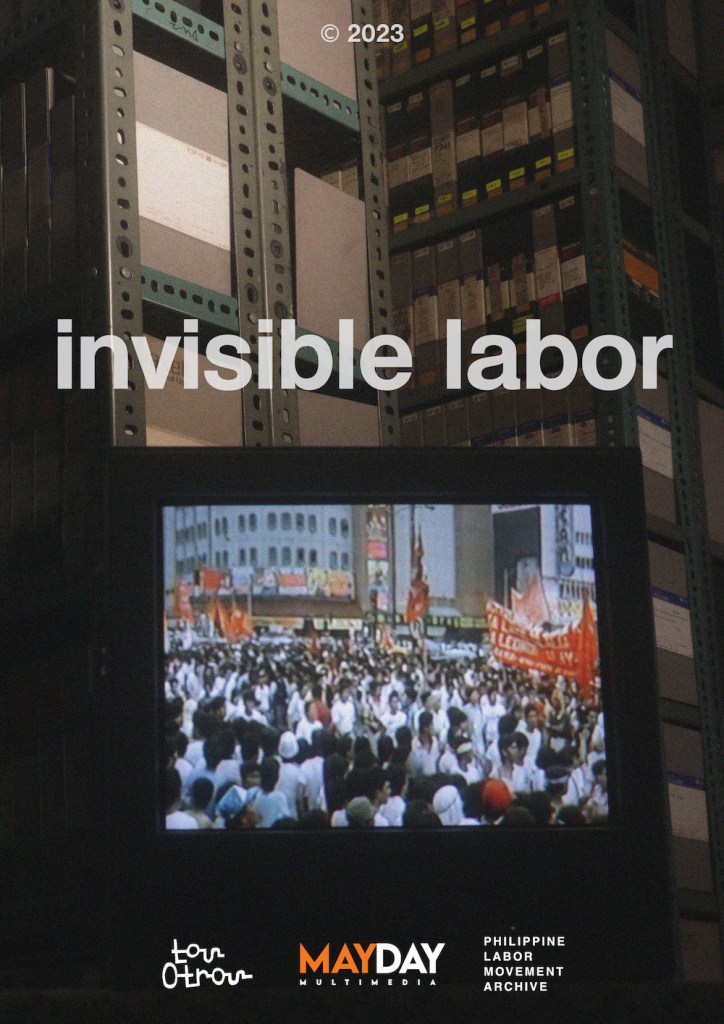
On the other hand, Joanne Cesario’s Invisible Labor centers the life of Cleto “Carlito” Piedad, a janitor at an independent research institution who, without formal training in archiving, unknowingly aided in the preservation of one of the most important video collections in the country’s history. The film examines Piedad’s legacy after eight continuous years of labor during lunchtime until his untimely death in 2006 and connects it to the larger labor movement in the country that has been sandwiched between the presidencies of Ferdinand Marcos Sr. and Ferdinand Marcos Jr.
Unlike Brownout Capital and Invisible Labor, Maria Estela Paiso’s Kay Basta Angkarabo Yay Bagay Ibat Ha Langit (Objects Do Not Fall Randomly From The Sky) is part-docufiction, part-animated film and places the audience squarely into the perspective of a young girl who has turned into a fish and recounts the struggles of the fisherfolk in her hometown, Zambales. Paiso, who is also part of this year’s Cannes Directors Factory with her co-direction effort Nightbirds, follows up her multi-award winning film It’s Raining Frogs Outside (2021) with another lush visual experiment containing her characteristic rage and rap influences.
“The documentaries in this year’s program are all works that challenge what it means to be a witness,” says Jason Tan Liwag, one of the programmers of this year’s QCinema. “Filmmakers look at the world and reexamine it through cinema by filming new footage, accessing and repurposing archives, or even using post-production to render moments familiar and alien. The gestalt is a collection of films that question our tenuous relationship with reality, history, politics, culture, society, and identities, and the many ways films allow manageable confrontation of not only the atrocities of today but also life’s deep and increasingly complex discomforts, pleasures, and joys.”
The QCinema International Film Festival will run from November 8 to 17. Details are available at qcinema.ph.

